Most couples spend weeks comparing fertility clinics and only minutes thinking about the doctor who will actually plan their treatment. Yet the IVF consultant you choose decides which tests you have, which protocol you start, how your embryos are handled and how honestly your chances are explained. This guide is not about which clinic has the glossiest brochure; it is about how to choose a fertility doctor. It explains the qualifications that genuinely matter, gives you 12 questions to take to your first appointment, and lists the red flags that should make you pause. If you want to see how our own team measures up, you can meet each Ridge IVF consultant and their training before you book.
Why the IVF consultant matters more than the brochure
IVF is a chain of decisions, and the consultant makes most of them. How strongly to stimulate the ovaries, when to trigger, whether to fertilise by conventional IVF or ICSI, whether to transfer fresh or freeze all embryos, how many embryos to put back: each choice depends on your age, ovarian reserve, semen report, uterine health and medical history. Two clinics can own similar equipment and still deliver very different care because the person interpreting your scans and reports is different.
A good consultant also sets the emotional tone of the journey. Treatment involves injections, waiting, uncertainty and sometimes disappointment. You need someone who explains clearly, answers questions without rushing and is honest when a treatment is unlikely to help.
Credentials worth understanding
Indian fertility specialists list a string of letters after their names. Here is what the common fertility specialist qualifications mean, so you can read a doctor’s profile with confidence.
The foundation: a degree in obstetrics and gynaecology
Almost every IVF doctor first trains as a gynaecologist. MS or MD (Obstetrics and Gynaecology) is a three-year postgraduate university degree; DNB (Obstetrics and Gynaecology) is the equivalent awarded by the National Board of Examinations in Medical Sciences. Either tells you the doctor is a fully trained gynaecologist, but not that they have specialised in reproductive medicine.
Super-speciality training in reproductive medicine
This is the layer that separates a gynaecologist who offers IVF from a reproductive medicine specialist. Look for a Fellowship of the National Board (FNB) in Reproductive Medicine, a structured fellowship with hands-on training in ovarian stimulation, egg collection, embryo transfer and andrology, or an MCh in Reproductive Medicine and Surgery, a super-speciality degree that adds advanced fertility-enhancing surgery such as hysteroscopy and laparoscopy.
International qualifications
MRCOG is membership of the Royal College of Obstetricians and Gynaecologists in the UK, earned by passing demanding examinations. Doctors who have cleared Part 2 (written as MRCOG-II) have shown a strong grasp of evidence-based gynaecology. It is a useful marker of rigour, though it is not itself a fertility qualification.
| Qualification | What it tells you | Fertility-specific? |
|---|---|---|
| MS / MD ObGyn | Fully trained gynaecologist (university degree) | No |
| DNB ObGyn | Fully trained gynaecologist (national board) | No |
| MRCOG | Passed UK Royal College examinations | No, but shows rigour |
| FNB Reproductive Medicine | Structured fellowship in IVF and reproductive medicine | Yes |
| MCh Reproductive Medicine & Surgery | Super-speciality degree including fertility surgery | Yes |
Experience you cannot read on a certificate
Qualifications are a starting point. Ask how many years the doctor has worked full time in fertility, whether they perform egg collections and embryo transfers themselves, and whether they regularly manage complex cases such as low ovarian reserve, endometriosis, recurrent implantation failure or severe male factor. Involvement in professional bodies and teaching also suggests a doctor who keeps up with changing evidence.
12 questions to ask at your first visit
These are the questions to ask an IVF doctor before you commit. Take this list with you, and write the answers down. A good IVF consultant will welcome these questions rather than deflect them.
- What do you think is causing our infertility? You should hear a working diagnosis, or a clear plan to find one, not just “let’s start IVF”.
- Do we actually need IVF, or could simpler treatment work first? Some couples are good candidates for ovulation induction or IUI before IVF.
- Which tests do we both need, and which have we already done adequately? Repeating every test is not always necessary.
- Which stimulation approach do you suggest for me, and why? The answer should refer to your age, AMH and antral follicle count.
- Will you personally do my egg collection and embryo transfer? Find out who else may be involved.
- Do we need ICSI, or is conventional IVF enough? ICSI has clear indications; it is not automatically better for everyone.
- How many embryos would you transfer, and what is your view on single-embryo transfer? Twin pregnancies carry higher risks for mother and babies.
- Would you transfer on day 3 or day 5, and fresh or frozen? Ask what decides this in your case.
- What are realistic chances for someone of my age and diagnosis? Ask how the figures are calculated, per started cycle, per transfer or per live birth.
- Which add-ons might you suggest, and what is the evidence for them? Laser hatching, IMSI and genetic testing help some patients, not all.
- Who can I contact if I have a problem at night or on a Sunday? Complications such as ovarian hyperstimulation do not keep office hours.
- What happens if this cycle does not work? A thoughtful consultant already has a plan B in mind.
Red flags to watch for
- Guarantees. No honest fertility doctor can promise a baby. “Guaranteed success” packages are a warning sign.
- Success rates without context. A single headline percentage that is not broken down by age, or does not say whether it counts pregnancies or live births, tells you very little.
- Every add-on for everyone. If you are offered a long list of extras before your history has even been taken, ask why.
- Pressure to transfer multiple embryos. Transferring more embryos raises the chance of twins or triplets far more than it raises the chance of a healthy baby.
- Offers of sex selection. Choosing the sex of a baby is illegal in India under the PCPNDT Act and the ART (Regulation) Act, 2021. A clinic that hints otherwise is not one to trust.
- No mention of registration or consent. ART clinics in India must be registered under the ART Act, and treatment requires written informed consent.
- You never see the same doctor twice. Continuity matters; a named consultant should be responsible for your plan.
What a good first consultation feels like
You should leave the first visit understanding more than when you arrived. Expect a detailed history from both partners, a review of every report you bring, and usually a transvaginal ultrasound to look at the uterus and count antral follicles. The male partner should be asked about his health and a semen analysis requested if one has not been done recently. If you are unsure whether you are ready for this stage, our guide on when to see an IVF specialist explains the age and time thresholds.
By the end, a careful doctor will outline the likely diagnosis, the tests still needed (often through a structured basic infertility workup), and two or three treatment options with their pros and cons. You should never feel that a decision about IVF has to be made on the spot.
The team behind the consultant
Your consultant leads, but outcomes depend on the whole team. Ask who the embryologists are and how experienced they are, whether there is an andrologist or urologist for male infertility, and whether a counsellor is available. Ask whether the laboratory can culture embryos to the blastocyst stage, since blastocyst transfer makes single-embryo transfer more practical. You can check a clinic’s registration on the national ART and Surrogacy portal.
How the Ridge IVF consultants fit this checklist
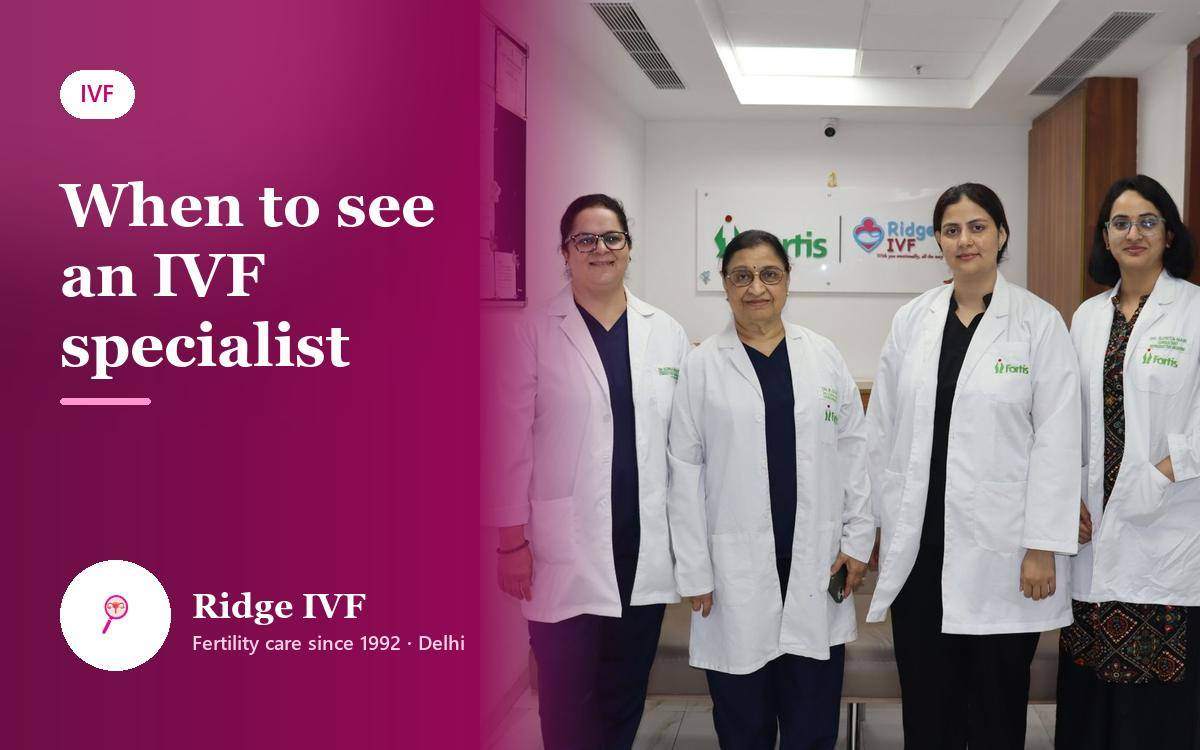
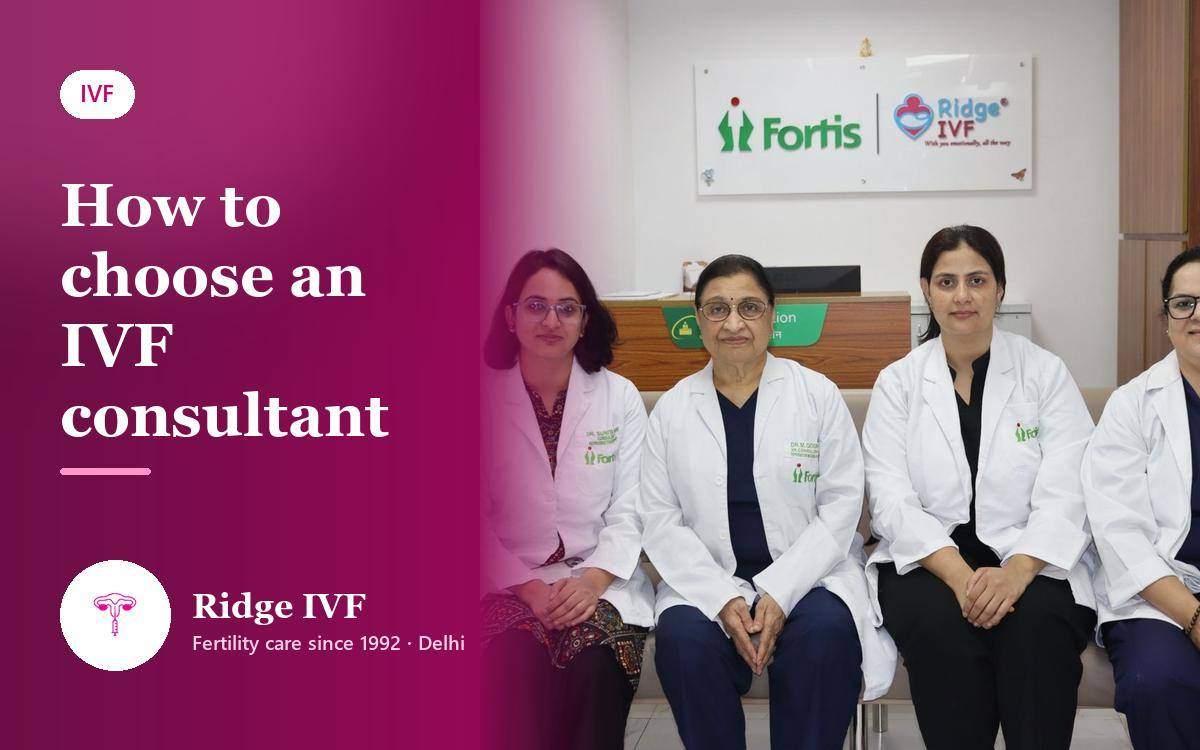
Ridge IVF is part of the Gouri Hospital group, which has offered infertility treatment since 1979 and IVF since 1992. The programme is led by Dr. M. Gouri Devi, Director of Reproductive Medicine, with more than 50 years of experience and a past President of the Indian Fertility Society. She is joined by Dr. Ruchi Hooda and Dr. Neeraj, both with FNB training in Reproductive Medicine, and Dr. Sunita Naik, who holds an MCh in Reproductive Medicine and Surgery. All three also hold MRCOG qualifications alongside their MS and DNB degrees.
Behind them is a team of around 20 people, including embryologists, andrologists, a urologist and a counsellor. You can read each doctor’s full background on our fertility specialists page and choose the person you feel most comfortable with.
Talk to a Ridge IVF specialist
Bring your reports and your list of questions. You can see a Ridge IVF consultant at our Jawahar Nagar centre near North Campus, at the Fortis Ridge Fertility & IVF Centre in Shalimar Bagh, or at our new Burari centre. Call or WhatsApp +91 88001 00326, or book a consultation online.
This article is for general information and is not a substitute for a personal consultation with a fertility specialist.
Frequently asked questions
Is a gynaecologist the same as a fertility specialist?
Not exactly. Every fertility specialist trains first as a gynaecologist, but a reproductive medicine specialist has completed further training, such as an FNB fellowship or an MCh, focused on IVF, ovarian stimulation, embryology and fertility surgery. A general gynaecologist can start basic tests and simple treatment, but complex cases and IVF are best planned by someone with dedicated reproductive medicine training.
Can I change my IVF doctor after a failed cycle?
Yes. Many couples seek a second opinion after one or two unsuccessful cycles, and a good doctor will not be offended. Bring your previous stimulation charts, egg and embryo reports, transfer details and all test results. These help a new consultant understand what happened and whether the protocol, laboratory approach or diagnosis should change in the next attempt.
Should both partners attend the first IVF consultation?
Ideally, yes. Infertility involves both partners, and around half of cases have a male contributing factor. When both attend, the doctor can take two medical histories, plan tests for each person and make sure decisions are shared. It also helps you both hear the same information and ask questions together, which makes the later stages of treatment easier.
How do I know if an IVF clinic in India is legally registered?
Under the ART (Regulation) Act, 2021, every ART clinic and ART bank must register on the national registry. You can ask the clinic for its registration details and check the national ART and Surrogacy portal. Registration means the clinic has to follow rules on consent, record keeping, donor gametes and a ban on sex selection.
The information on this website is for general education and does not replace a consultation. Treatment plans and outcomes differ from person to person; no treatment can guarantee pregnancy or a live birth.