
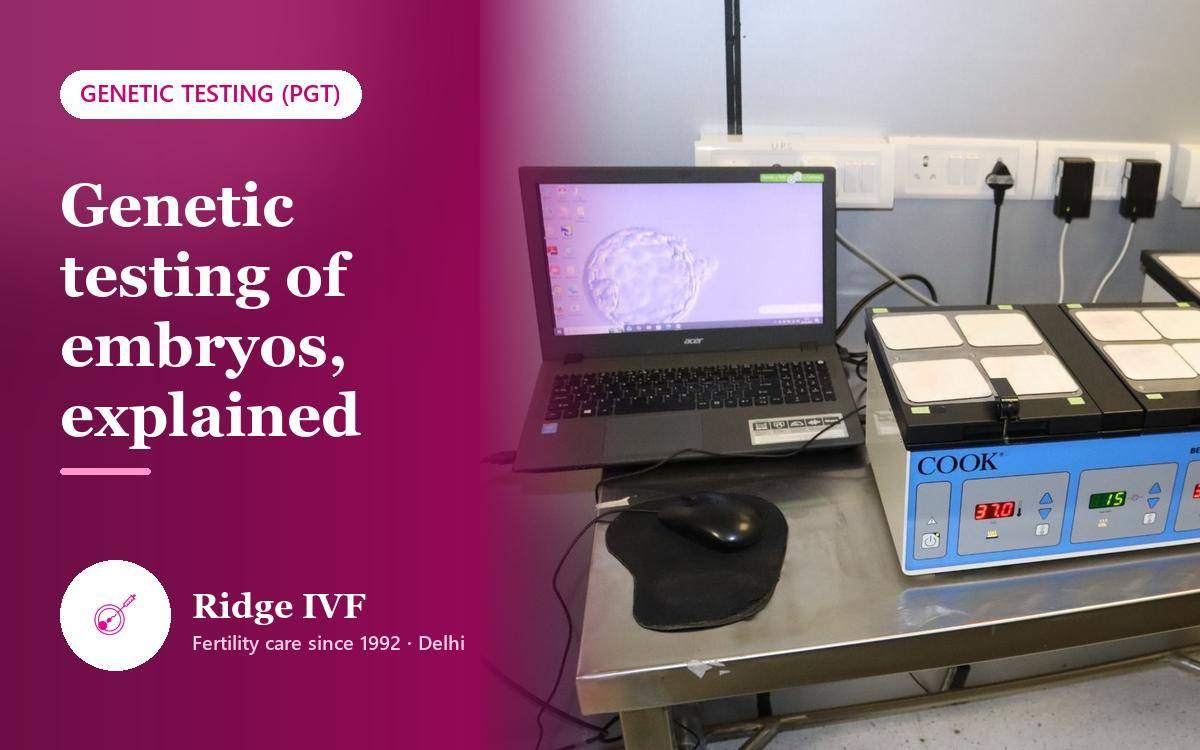
Once couples decide that embryo testing is right for them, a new set of questions appears. What exactly does the laboratory look at? How can a few cells tell you anything about a whole embryo? And what does it mean when a report says “mosaic”? This guide focuses on the science behind PGD and PGS genetic testing — now known as PGT-M, PGT-SR and PGT-A — and on how to interpret what comes back. If you are still deciding whether testing suits you at all, start with our article on who needs PGD and PGS treatment.
What PGD and PGS genetic testing actually examines
Every cell in an embryo should carry 23 pairs of chromosomes, the packages of DNA inherited from each parent. Genetic testing of embryos asks one of two questions:
- Is a specific change present? For PGT-M, the lab checks whether the embryo has inherited a known family mutation, for example the beta-thalassaemia gene from both carrier parents. For PGT-SR, it checks whether a parent’s balanced translocation has been passed on in an unbalanced form.
- Are the chromosome numbers correct? For PGT-A, the lab counts whether each chromosome is present in two copies, rather than one (monosomy) or three (trisomy, as in Down syndrome).
The material comes from a biopsy of roughly five to ten cells from the trophectoderm, the outer layer of a day-5 or day-6 blastocyst. The tiny amount of DNA in those cells is first copied millions of times, a process called whole-genome amplification, so that there is enough to analyse. Throughout this period the embryo itself stays safely frozen in the IVF laboratory.
The technologies behind embryo testing
Next-generation sequencing (NGS)
NGS embryo testing is now the most widely used method for PGT-A and PGT-SR. The amplified DNA is broken into fragments, millions of which are read by a sequencer. Software then maps those reads to each chromosome. If chromosome 21 has about one and a half times the expected number of reads, it suggests a trisomy; if it has half, a monosomy. NGS can also pick up large missing or extra segments within a chromosome, and it can suggest when a sample is a mixture of normal and abnormal cells.
Targeted tests for single-gene conditions
For PGT-M the lab designs a test around your family’s mutation. Most laboratories combine direct detection of the mutation with linkage analysis, which tracks DNA markers lying close to the gene. Using markers on either side acts as a cross-check: if the mutation signal fails in one sample, the markers still show which parental chromosome the embryo inherited. This is why samples from both partners, and sometimes from an affected child or grandparents, are requested before the cycle starts.
Older methods
You may come across older reports that used FISH or array-CGH. FISH could check only a handful of chromosomes and is no longer recommended for screening. Array-CGH could check all 24 chromosome types and was widely used before NGS largely replaced it.
Mosaic embryos: the grey zone
An embryo is not always uniformly normal or abnormal. Errors in cell division after fertilisation can produce a mixture of cell lines, a state called mosaicism. When a biopsy contains both normal and abnormal cells, NGS shows an intermediate signal, and the report labels the embryo as mosaic, often described as “low-level” or “high-level” depending on the proportion of abnormal cells.
Mosaic embryo results are one of the most debated areas in reproductive medicine:
- A biopsy samples only a few cells, so it may not represent the inner cell mass that becomes the baby.
- Published reports show that a proportion of transferred mosaic embryos have led to healthy babies, although implantation rates tend to be lower and miscarriage rates higher than with euploid embryos.
- Some apparent mosaicism is a technical artefact of amplification rather than true biology.
International bodies now advise that mosaic embryos should not automatically be discarded. Whether to transfer one depends on which chromosome is involved, the level of mosaicism, whether other embryos are available, and your own views after counselling.
How accurate is PGD and PGS genetic testing?
Modern testing is highly reliable for what it is designed to detect, but no embryo test is perfect. Several factors limit accuracy:
- Biological limits. Mosaicism means the biopsy may differ from the rest of the embryo, causing both false-positive and false-negative results.
- Amplification problems. Copying a tiny amount of DNA can introduce noise. In PGT-M, one of the two gene copies can fail to amplify (“allele drop-out”), which is why linked markers are used as a back-up.
- Contamination. Stray cells or sperm can distort results, which is one reason ICSI is routinely used and strict lab hygiene is essential.
- No-result samples. A small share of biopsies fail to give a readable result; the embryo may then need re-biopsy after thawing, or a decision has to be made without data.
- Scope. PGT-A checks chromosome numbers, not single-gene diseases, and PGT-M checks only the family’s condition. Neither is a screen for every possible problem.
On PGT-A accuracy specifically, the main debate is less about lab error and more about whether an “abnormal” label always means an embryo could never become a healthy baby. Because of these limits, prenatal testing during pregnancy is still recommended. Regulators such as the UK’s Human Fertilisation and Embryology Authority also publish balanced patient guidance on the evidence for PGT-A.
Reading a PGT report
Each laboratory has its own format, but most reports list every biopsied embryo with an identifier matching the IVF lab’s records, its day and grade, and a result category. Common categories include:
| Report result | What it usually means | Usual next step |
|---|---|---|
| Euploid / normal | Expected number of chromosomes detected | Suitable for transfer, usually one at a time |
| Aneuploid / abnormal | Extra or missing whole chromosome(s) or large segments | Generally not transferred |
| Mosaic (low or high level) | Mixture of normal and abnormal cells in the biopsy | Discussed individually after genetic counselling |
| Unaffected (PGT-M) | Family mutation not inherited, or carrier only for recessive conditions | Suitable for transfer |
| Affected (PGT-M) | Embryo has inherited the condition | Not transferred |
| No result / inconclusive | DNA could not be read reliably | Options include re-biopsy or counselling on risks |
The report will not, and legally must not, be used to select an embryo by sex. Indian law permits embryo testing only for genetic disease and chromosomal abnormalities.
Genetic counselling: before and after the test
Counselling is not a formality. Before testing, a counsellor or doctor explains what the test can and cannot detect, the chance of having no suitable embryo, and how mosaic or inconclusive results will be handled, so that you make those decisions calmly in advance. After results arrive, a second conversation helps you choose which embryo to transfer first and what to do with embryos that are not suitable.
Counselling is also where practical worries are addressed: the emotional impact of finding that no embryo is suitable, how many embryos might reasonably be expected at your age, and what to do with embryos that are affected by a serious condition. Couples sometimes discover during these sessions that they hold different views, and it is far better to discuss that before stimulation than after results arrive.
At Ridge IVF, your consultant will tell you whether PGT is advisable and how testing is arranged with an accredited genetics laboratory. The biopsy and freezing happen as part of your IVF treatment, while the DNA analysis is performed by that specialist laboratory, and our doctors go through the report with you.
Questions worth asking about the laboratory
- Which technology is used — NGS for chromosome screening, and what method for single-gene testing?
- How does the laboratory define and report mosaicism?
- What is its usual rate of no-result samples, and what happens if one occurs?
- How long do results take, and how are frozen embryos labelled and matched to the report?
- Will we receive a written report and an appointment to discuss it?
If your family has a known genetic condition, these discussions begin weeks before stimulation, so it helps to read about how embryo testing fits into the IVF cycle early.
Talk to a Ridge IVF specialist
Bring any genetic reports, karyotypes or previous PGT results to your appointment and we will help you understand them in plain language. Book a consultation at Jawahar Nagar, Fortis Shalimar Bagh or Burari, or call or WhatsApp +91 88001 00326.
This article is for general information and is not a substitute for a personal consultation with a fertility specialist.
Frequently asked questions
What is the difference between NGS and older embryo tests?
Next-generation sequencing reads millions of DNA fragments and counts them against every chromosome, so it can detect extra or missing chromosomes, large segment changes and suggest mosaicism. Older FISH tests could check only a few chromosomes, and array-CGH, though comprehensive, was less able to detect mosaic patterns. Most laboratories now use NGS for chromosome screening.
Can a mosaic embryo lead to a healthy baby?
Sometimes, yes. Healthy births after mosaic embryo transfer have been reported, although implantation tends to be lower and miscarriage higher than with euploid embryos. The outcome depends on the chromosome involved and the level of mosaicism. Transfer is usually considered only when no euploid embryo is available and after detailed genetic counselling about the possible risks.
How long do PGT results take?
Results commonly take one to three weeks after the biopsy, depending on the laboratory, the type of test and transport time. Because the embryos are frozen after biopsy, there is no rush; the transfer is planned for a later cycle once results have been reviewed with your doctor. PGT-M also needs set-up time before the IVF cycle begins.
Why would a sample give no result?
The biopsy contains only a few cells, and sometimes the DNA does not amplify well enough to be read reliably, or the cells are damaged during handling. When this happens, the embryo can sometimes be thawed, re-biopsied and refrozen, though each step carries a small risk. Your doctor will discuss whether re-testing or another approach is sensible.
The information on this website is for general education and does not replace a consultation. Treatment plans and outcomes differ from person to person; no treatment can guarantee pregnancy or a live birth.