“Do we need ICSI, or will normal IVF do?” is one of the most common questions couples ask once IVF is on the table. ICSI treatment (intracytoplasmic sperm injection) has transformed the outlook for male infertility, and today it is used in a large share of IVF cycles worldwide. But being widely used is not the same as being needed by everyone. This article compares ICSI with conventional IVF, sets out the clear medical reasons for choosing it, explains where the evidence says it adds little, and answers the safety questions parents understandably ask. You can read how the procedure is performed at our centres on the ICSI treatment at Ridge IVF page.
Conventional IVF and ICSI: the one step that differs
Most of an IVF cycle is identical whether or not ICSI is used. The woman has ovarian stimulation, the eggs are collected under sedation, the male partner provides a semen sample (or sperm is retrieved surgically), embryos are cultured in the laboratory, and one embryo is transferred to the uterus. The difference lies in a single step: how the egg and sperm are brought together.
- Conventional IVF (insemination): each egg is placed in a culture dish with tens of thousands of prepared, motile sperm. The sperm must bind to and penetrate the egg’s outer shell on their own, just as they would in the body. Nature does the selection.
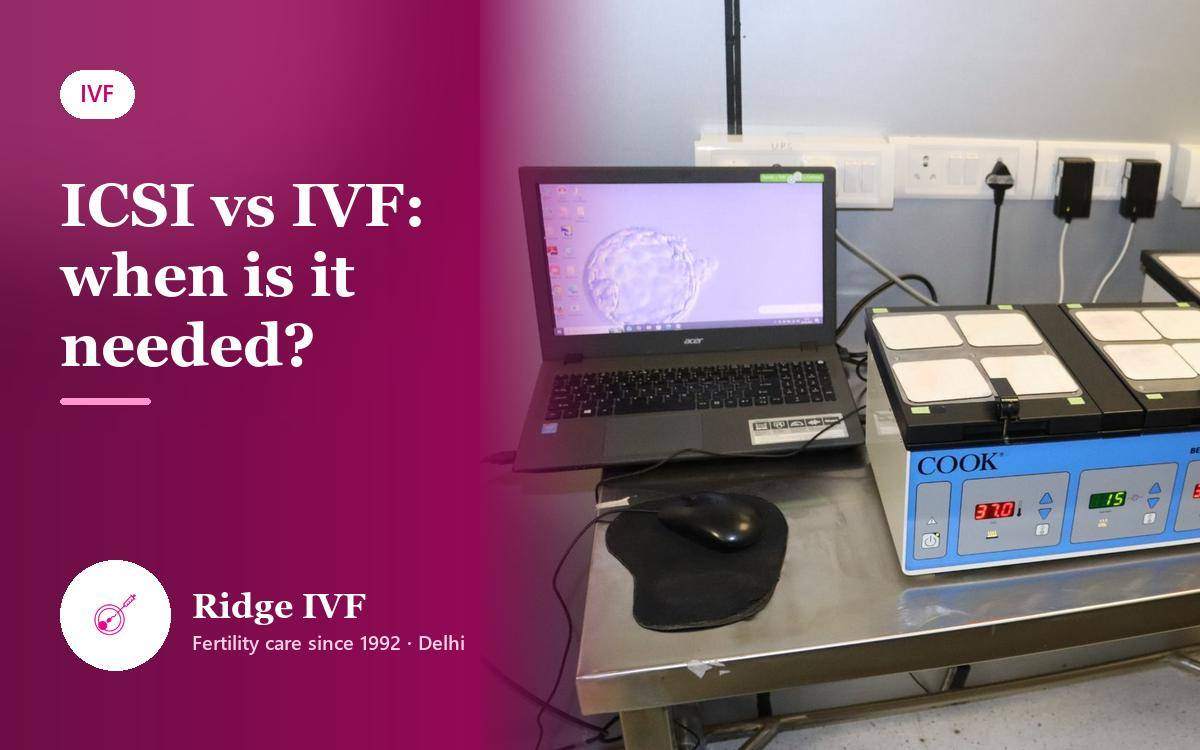
- ICSI: an embryologist, working under a high-powered microscope, picks up a single sperm with a fine glass needle and injects it directly into the centre of each mature egg. The sperm does not need to swim to the egg or get through its shell.
After this step, the embryos are checked for fertilisation the next morning and cultured in the same way, whether the cycle used ICSI or conventional IVF. For the full sequence of an IVF cycle, see our treatment page.
Clear indications for ICSI treatment
ICSI was developed for male infertility, and that is where its benefit is best established. Your consultant is likely to recommend it in these situations:
Male factor infertility
- A significantly low sperm count, poor motility or a high proportion of abnormal forms, well below the WHO 2021 reference limits (16 million/mL concentration, 42% total motility, 4% normal forms).
- Too few motile sperm after washing to give conventional insemination a fair chance.
- High levels of antisperm antibodies, which can stop sperm binding to the egg.
Surgically retrieved or frozen sperm
- Sperm obtained by TESA, PESA or micro-TESE in men with azoospermia (no sperm in the ejaculate). These samples contain very few sperm, often with limited movement. See our page on male infertility care.
- Frozen sperm samples of limited quantity, for example sperm banked before cancer treatment.
Laboratory reasons
- Previous fertilisation failure, where few or none of the eggs fertilised in an earlier conventional IVF cycle despite apparently normal sperm.
- Frozen (vitrified) eggs, whose outer shell can harden after thawing.
- Eggs intended for genetic testing (PGT), where ICSI is often preferred so that no stray sperm attached to the shell contaminates the DNA sample.
- Very few eggs collected, in some cases, so that each egg has a chance to fertilise; this is a judgment call rather than a firm rule.
When ICSI doesn’t add value
Because ICSI bypasses the most common reason for fertilisation failure, it can seem logical to use it “just to be safe” in every cycle. However, good-quality studies and international guidance (including from ASRM and ESHRE) have found that in couples without male factor infertility, ICSI does not improve live birth rates compared with conventional IVF. Situations where routine ICSI has not shown benefit include:
- unexplained infertility with a normal semen analysis;
- tubal factor infertility with normal sperm;
- advanced maternal age alone;
- low ovarian reserve alone, in most studies.
In these cases, conventional IVF allows natural selection at the point of fertilisation, avoids the small physical risk of the injection damaging an egg, and costs less. Some couples and clinics still choose ICSI in specific circumstances, and that can be reasonable, but it should be a discussed decision rather than an automatic add-on.
A practical middle path some clinics use is a “split” approach, where half the eggs are inseminated conventionally and half receive ICSI. This is occasionally offered when the semen sample is borderline on the day, or when there is uncertainty after a previous cycle. Ask your doctor whether it makes sense for you.
ICSI vs conventional IVF at a glance
| Feature | Conventional IVF | ICSI |
|---|---|---|
| How fertilisation occurs | Sperm penetrate the egg on their own in a dish | One sperm is injected into each mature egg |
| Sperm needed | Many thousands of motile sperm | One viable sperm per egg |
| Best suited for | Tubal factor, unexplained infertility, normal semen | Male factor, surgical sperm, past fertilisation failure, frozen eggs |
| Immature eggs | Can mature and fertilise in some cases | Only mature (MII) eggs can be injected |
| Risk of total fertilisation failure | Higher if sperm function is poor | Lower, though not zero |
| Laboratory skill and time | Standard | Higher; depends on embryologist expertise |
Safety questions parents ask about ICSI
Can the injection harm the egg?
A small proportion of eggs, typically a few percent, may be damaged during the injection and fail to develop. Skilled embryologists keep this low, but it is one reason ICSI is not performed without a reason.
Are babies born after ICSI healthy?
The large majority of children born after ICSI are healthy, and long-term follow-up studies are broadly reassuring. Some studies have reported a slightly higher rate of certain birth defects and chromosomal differences compared with natural conception. Part of this appears to be linked to the underlying infertility, particularly severe male factor, rather than the technique itself. The overall absolute risk remains low.
Can male infertility be passed on?
Yes, in some cases. Certain causes of severe male infertility are genetic, such as Y-chromosome microdeletions, chromosomal changes like Klinefelter syndrome, or cystic fibrosis gene variants linked to absent vasa deferentia. A son conceived by ICSI could inherit the same fertility problem. For this reason, men with very low counts or azoospermia are often advised karyotype and Y-microdeletion testing, and genetic counselling, before ICSI.
Does ICSI guarantee fertilisation?
No. In most cycles a majority of mature eggs fertilise, but some will not, and occasionally none do. Fertilisation also does not guarantee a good embryo; egg quality, which is closely linked to the woman’s age, remains the strongest factor.
What is PICSI and who might it help?
PICSI (physiological ICSI) is a variation in which sperm are placed on a dish coated with hyaluronan, a substance naturally found around the egg. Mature sperm with normal DNA packaging tend to bind to hyaluronan, and the embryologist selects a bound sperm for injection. The idea is to pick sperm that are more mature and less likely to have DNA damage.
The evidence for PICSI is mixed. A large UK trial found that it did not improve live birth rates overall, although it was associated with fewer miscarriages. Because of this, PICSI is generally considered for selected couples rather than routinely, for example those with:
- high sperm DNA fragmentation;
- recurrent miscarriage linked to sperm factors;
- repeated poor embryo development despite good eggs.
Ridge IVF offers PICSI as well as IMSI, which uses much higher magnification to examine sperm shape. If you want to understand how IMSI compares, read IMSI vs ICSI. As with any add-on, ask what the evidence says for your particular situation.
Questions to ask before agreeing to ICSI
- What in our reports is the specific reason for recommending ICSI?
- Would conventional IVF be equally reasonable for us, or a split approach?
- Should the male partner have genetic tests or a DNA fragmentation test first?
- What proportion of mature eggs usually fertilise after ICSI in your laboratory?
- Is PICSI or IMSI being suggested, and why?
A good clinic will welcome these questions. Clear answers help you understand not just what is being done, but why.
Talk to a Ridge IVF specialist
Whether ICSI is right for you depends on your semen analysis, previous treatment history and the wider picture of your fertility. Our consultants and embryology team can review your reports and explain whether sperm injection genuinely improves your chances. Book a consultation at Ridge IVF Jawahar Nagar, Fortis Shalimar Bagh or Burari, or call or WhatsApp +91 88001 00326.
This article is for general information and is not a substitute for a personal consultation with a fertility specialist.
Frequently asked questions
Does ICSI increase the chance of twins?
No. ICSI only changes how the egg is fertilised in the laboratory. The chance of twins depends on how many embryos are transferred to the uterus. Transferring a single good-quality embryo, often a blastocyst, keeps the twin risk low whether ICSI or conventional IVF was used. Your doctor will discuss the number of embryos to transfer, keeping regulations, your age and your health in mind.
Can ICSI be done with sperm that do not move?
Sometimes. Non-moving sperm may still be alive, and embryologists can use special tests to identify living sperm suitable for injection. This is more common with surgically retrieved samples. However, fertilisation and pregnancy rates may be lower when only immotile sperm are available. The male partner's evaluation will help your team estimate what to expect and whether additional sperm retrieval is worthwhile.
Does ICSI take longer than a normal IVF cycle?
No. From the patient's point of view the timeline is the same: stimulation, egg collection, laboratory culture and embryo transfer. ICSI is performed in the laboratory on the day of egg collection, a few hours after the eggs are retrieved. The couple does not need any extra visits or procedures because of ICSI itself, apart from any tests advised beforehand for the male partner.
Is ICSI painful for the woman?
ICSI itself involves no procedure on the woman. It is carried out on the eggs in the laboratory after they have been collected. The parts of treatment the woman experiences, such as injections during stimulation, egg collection under sedation and embryo transfer, are exactly the same as in conventional IVF. Any discomfort relates to those steps, not to the sperm injection technique.
The information on this website is for general education and does not replace a consultation. Treatment plans and outcomes differ from person to person; no treatment can guarantee pregnancy or a live birth.