One of the most common questions in the IVF laboratory waiting area is, “Why are you waiting until day 5? Wouldn’t the embryo be safer back inside me sooner?” It is a fair question. This article compares blastocyst transfer on day 5 with cleavage-stage transfer on day 3, explains how embryologists grade embryos at each stage, and looks at how the choice links to single-embryo transfer and to fresh versus frozen cycles. It assumes you already know the basic steps of an IVF treatment cycle.
What happens to an embryo between day 1 and day 5
After egg collection, the eggs are fertilised by IVF or ICSI. On day 1, the embryologist checks for two pronuclei, the sign of normal fertilisation. From then on, development follows a broad timetable:
- Day 2: around 2 to 4 cells.
- Day 3: ideally about 6 to 8 cells. This is the “cleavage stage”.
- Day 4: the cells compact into a ball called a morula.
- Day 5 to 6: a fluid-filled cavity forms and the embryo becomes a blastocyst, with two distinct cell groups.
An important biological point sits in the middle of this timeline. Up to about day 3, the embryo relies largely on instructions stored in the egg. Around the 4 to 8 cell stage, the embryo’s own genes switch on. Some embryos that look perfect on day 3 stop developing after this switch, often because of chromosomal or other problems that cannot be seen under the microscope.
Day 3 transfer: how it works and how embryos are graded
On day 3, embryologists judge embryos mainly on:
- Cell number: 7 to 8 cells is generally considered on track.
- Fragmentation: small pieces of cellular material; less is better.
- Symmetry: cells of similar size.
- Multinucleation: more than one nucleus in a cell, which is a less favourable sign.
Day 3 grading tells us how an embryo is doing so far, but it predicts later development only partly. That is the main limitation of day 3 transfer: when several embryos look similar, it is harder to choose the one most likely to implant.
Blastocyst transfer and Gardner grading
A blastocyst has three features that embryologists score, usually with the Gardner system. The grade is written as a number followed by two letters, for example 4AA or 3BB.
The number: expansion
- Early blastocyst, cavity less than half the embryo.
- Cavity half or more of the embryo.
- Full blastocyst, cavity filling the embryo.
- Expanded blastocyst, larger, with a thinning outer shell (zona).
- Hatching blastocyst, starting to emerge from the zona.
- Fully hatched blastocyst.
The first letter: inner cell mass
The inner cell mass becomes the baby. A means many tightly packed cells, B means several loosely grouped cells, and C means very few cells.
The second letter: trophectoderm
The trophectoderm becomes the placenta. A means many cells forming a cohesive layer, B means fewer cells forming a loose layer, and C means very few large cells.
Grades are a guide, not a verdict. A 3BB or 4BC blastocyst can and often does lead to a healthy baby, and a top-grade blastocyst does not guarantee pregnancy. Grading helps choose between embryos; it cannot see chromosomes. Some laboratories add time-lapse observations, but grading under the microscope remains the standard tool.
Day 5 vs day 3 embryo transfer compared
| Factor | Day 3 (cleavage stage) | Day 5 (blastocyst) |
|---|---|---|
| Implantation chance per embryo transferred | Lower on average | Higher on average |
| Ability to choose between embryos | Limited | Better, as weaker embryos tend to arrest |
| Risk of no embryo to transfer | Lower | Higher, because some embryos stop before day 5 |
| Suitability for single-embryo transfer | Possible but less confident | Well suited |
| Match with natural timing | Embryo would normally still be in the tube | Embryo would normally be in the uterus by now |
The overall picture from research is that, for women with a good number of embryos, transferring on day 5 gives a higher live birth rate per transfer. What is less clear is whether it increases the total chance of a baby from all embryos in one egg collection, because some embryos that might have implanted on day 3 are lost in culture. That is the honest trade-off.
Who usually suits a day 5 transfer, and who might not
Day 5 is often advised when
- There are several good-quality embryos on day 3 and a choice needs to be made.
- The plan is to transfer a single embryo and freeze the rest.
- Embryos will be frozen for later use, since blastocysts generally survive vitrification well.
- Your consultant recommends genetic testing (PGT). Your Ridge IVF consultant will tell you whether PGT is advisable and how testing is arranged with an accredited genetics laboratory.
Day 3 may be considered when
- Only one or two embryos have formed, so there is no real choice to make.
- Previous cycles produced embryos that repeatedly arrested in extended culture.
Even in these situations, practice varies, and the decision depends on your age, history and the laboratory’s experience. It is a good question to discuss on the day the embryology update is given.
Single embryo transfer: why day 5 makes it easier
Twins and triplets carry real risks: preterm birth, low birth weight, and higher chances of pregnancy complications such as pre-eclampsia and diabetes for the mother. The safest way to reduce these risks is to transfer one embryo at a time.
Many couples worry that putting back one embryo halves their chances. With a good blastocyst, that is often not the case: the chance of a pregnancy from one top-quality blastocyst can be close to that of two, while avoiding most twin pregnancies. The remaining good blastocysts can be frozen and transferred one by one, so the cumulative chance from that egg collection is preserved. The ART (Regulation) Act also limits how many embryos may be transferred, reflecting this safety concern.
Fresh or frozen blastocyst transfer?
Thanks to vitrification, a very fast freezing technique, frozen blastocysts survive thawing in the large majority of cases. That has made “freeze-all” cycles more common. Neither approach is right for everyone.
A fresh transfer may suit
- Women with a normal response to stimulation and no signs of ovarian hyperstimulation.
- Cycles where hormone levels and the uterine lining look favourable on the day of trigger.
Freezing all embryos and transferring later may be advised when
- There is a risk of ovarian hyperstimulation syndrome (OHSS).
- Progesterone has risen early, or the lining is not ideal.
- Embryo testing is planned, or a medical issue such as a polyp needs treating first.
Large studies suggest that freeze-all does not improve outcomes for every woman, but it is clearly safer for those at risk of OHSS. A frozen transfer can be done in a natural cycle or a hormone-prepared cycle, and the choice is tailored to your cycle pattern. Blastocysts that have been frozen sometimes have a hardened or thicker zona, which is one situation where some clinics consider laser-assisted hatching; our article on who benefits from laser hatching looks at that evidence honestly.
Questions to ask your embryologist
- How many embryos reached day 3, and what were their grades?
- How many do you expect to reach day 5, and what happens if none do?
- What grade is the blastocyst being transferred, and how many are being frozen?
- Is a fresh or frozen transfer better in my particular situation?
Our consultants, including Dr. Sunita Naik, and our embryology team discuss these points with every couple. To understand how we plan day-5 culture and transfers, see our page on blastocyst culture and transfer at Ridge IVF.
Talk to a Ridge IVF specialist
If you are about to start IVF or are deciding between day 3 and day 5 for your next cycle, book a consultation at our Jawahar Nagar centre, the Fortis Ridge Fertility & IVF Centre in Shalimar Bagh, or our Burari centre, or call or WhatsApp +91 88001 00326. We will look at your history and embryo development and explain the options clearly.
This article is for general information and is not a substitute for a personal consultation with a fertility specialist.
Frequently asked questions
Is an embryo safer inside the uterus than in the laboratory incubator?
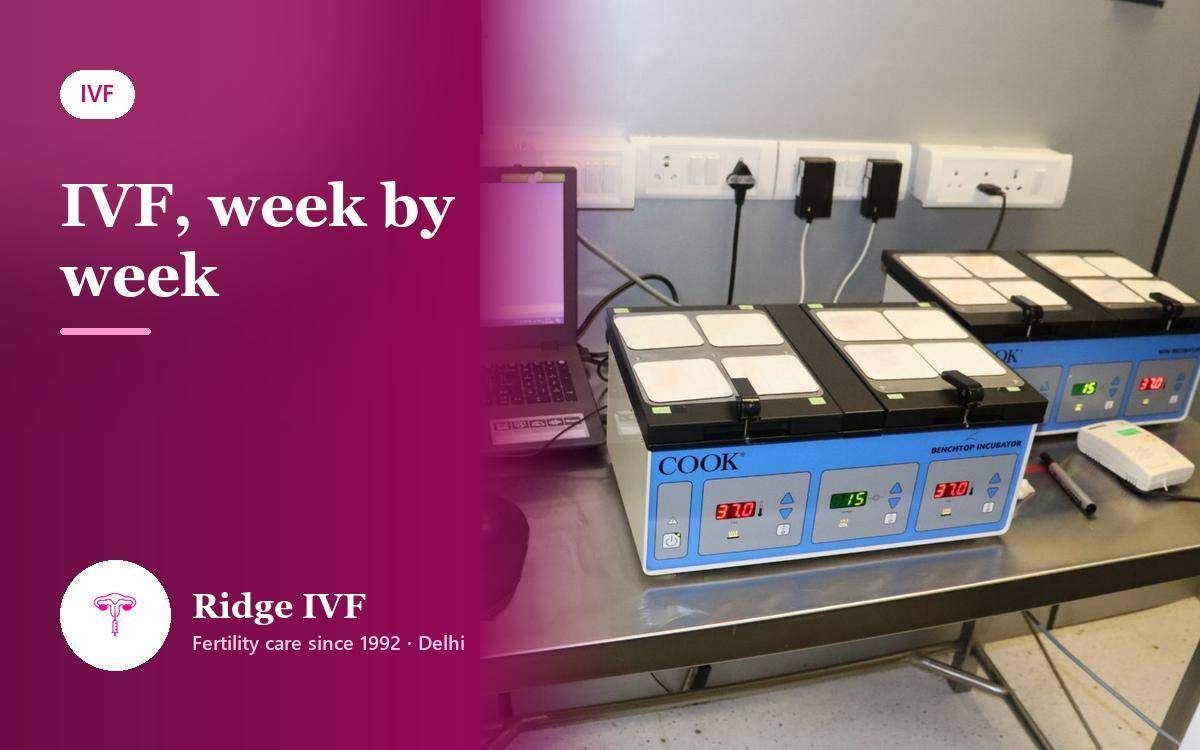
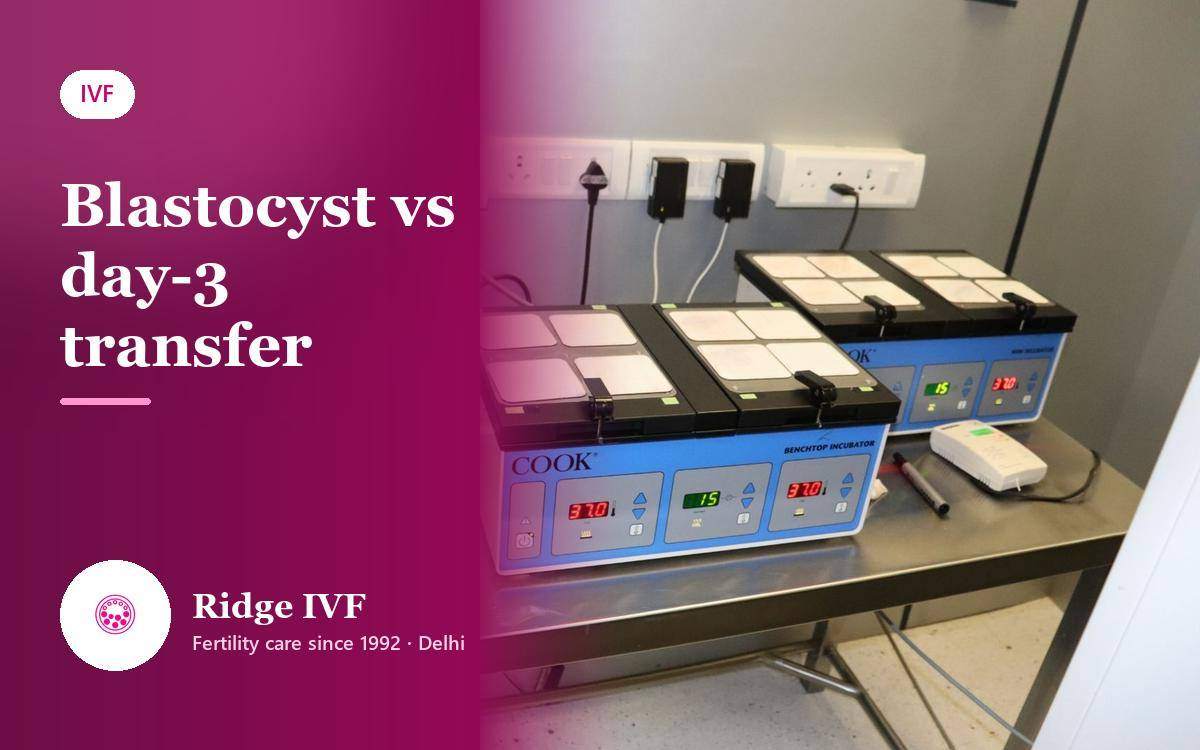
Modern incubators keep temperature, gases and humidity very stable, and embryos develop well in culture up to day 5 or 6. In natural conception the embryo reaches the uterus around day 5 anyway. Embryos that stop growing in the laboratory are usually those that would not have continued in the body either, so extended culture mostly reveals rather than causes the problem.
What does it mean if none of my embryos reached the blastocyst stage?
It is disappointing, but it gives useful information. It may reflect egg or sperm quality, the number of eggs collected, or chromosomal problems, which become more common with age. Your consultant will review the cycle, the stimulation used and the sperm findings, and may suggest changes such as a different protocol, ICSI, or a day 3 transfer in future.
Can a blastocyst graded 3BB still result in a baby?
Yes. Gardner grades describe how an embryo looks at one moment, not its chromosomes or its full potential. Many healthy babies are born from blastocysts graded B for inner cell mass or trophectoderm. Higher grades are linked to somewhat better implantation rates on average, but a lower grade is not a reason to lose hope.
How long can frozen blastocysts be stored?
Vitrified embryos remain stable in liquid nitrogen for many years, and the length of storage does not seem to affect their survival or quality. Indian law sets storage limits under the ART (Regulation) Act and Rules, and you will be asked to sign consent forms about storage duration and what should happen to unused embryos. Your clinic will explain the current requirements.
The information on this website is for general education and does not replace a consultation. Treatment plans and outcomes differ from person to person; no treatment can guarantee pregnancy or a live birth.