If you have searched for ways to improve your chances in IVF, you have probably come across assisted hatching. It sounds logical: help the embryo break out of its shell and it should implant more easily. The reality is more nuanced. This article explains what laser hatching treatment actually involves, summarises what the research does and does not show, and sets out the groups of patients in whom it might be worth considering. Our aim is to help you have an informed conversation with your doctor, not to sell an add-on.
What the zona pellucida is, and why hatching matters
Every egg, and the embryo that grows from it, is surrounded by a clear protective shell called the zona pellucida. The zona holds the early cells together and protects the embryo as it travels down the fallopian tube. By about day 5 or 6, the embryo has become a blastocyst. It expands, the zona thins, and the embryo pushes its way out. This natural “hatching” must happen before the embryo can attach to the lining of the uterus.
The idea behind assisted hatching is that, in some embryos, the zona may be unusually thick or hard, making it difficult for the embryo to escape. Creating a small opening or thinning a section of the zona might, in theory, help.
How laser hatching treatment is done
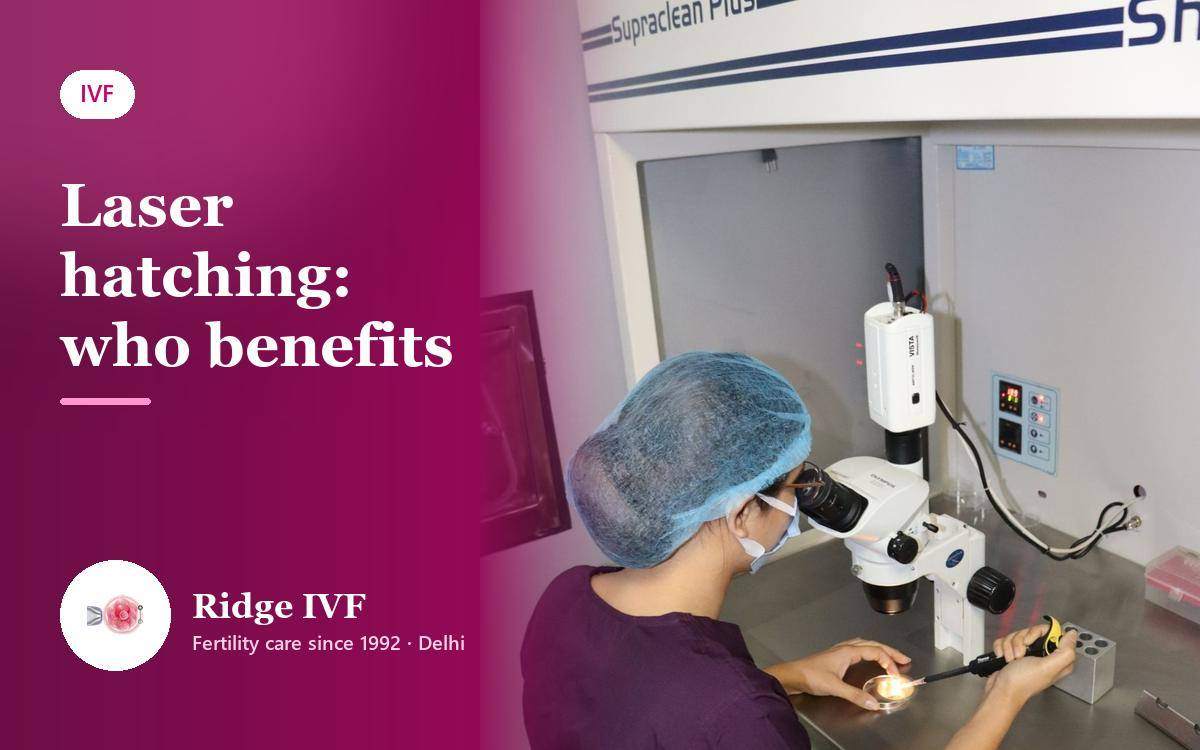
Older methods used acid solutions or fine glass needles. Today most laboratories use a precisely focused laser attached to the microscope. The process is quick:
- The embryo is held gently in a dish under the microscope, usually on day 3 or at the blastocyst stage.
- The embryologist aims the laser at a small area of the zona, away from the embryo’s cells.
- A few very brief pulses either thin that area or create a small gap.
- The embryo is returned to the incubator and transferred as planned, or the procedure is done just before a frozen embryo transfer.
You will not feel anything, and there is no change to your transfer procedure. The laser is applied in the laboratory, not to your body. Because the step takes only seconds in skilled hands, the embryo spends very little extra time outside the incubator.
What the evidence actually shows
This is where honesty matters. Laser assisted hatching IVF has been studied for decades, and the overall evidence is limited and mixed:
- Systematic reviews pooling many trials suggest assisted hatching may slightly increase clinical pregnancy rates in some groups, but the effect on live birth, the outcome that matters most, is uncertain.
- Some analyses have found a small increase in multiple pregnancy rates, possibly because hatching may encourage an embryo to split into identical twins.
- Many of the trials were small, used different methods and included different patient groups, which makes firm conclusions difficult.
Professional bodies reflect this uncertainty. The American Society for Reproductive Medicine and ESHRE do not recommend assisted hatching routinely for all IVF patients. The UK regulator, the HFEA, lists assisted hatching among treatment add-ons for which there is not enough good evidence that it improves the chance of having a baby for most patients.
Why the studies disagree
Part of the confusion comes from how differently assisted hatching has been tested. Some trials hatched embryos on day 3, others at the blastocyst stage. Some used acid, some used a laser, and some thinned the zona while others opened it completely. Patient groups ranged from young women in their first cycle to older women with several failed transfers. When such different studies are pooled, a small benefit in one group can be hidden by no benefit in another, or a chance finding in a small trial can look more important than it is.
What this means for you is simple: a clinic quoting a single impressive figure for hatching should be asked where that figure comes from, which patients it applies to, and whether it refers to pregnancy tests or to babies born. The overall success of an IVF treatment cycle depends far more on age, embryo quality and the uterus than on any single laboratory add-on.
In short: assisted hatching is not a general booster. If it helps at all, it is likely to be in selected situations, and even there the benefit is modest and not guaranteed.
Who might benefit from laser hatching treatment
Although routine use is not supported, there are specific situations in which some specialists consider assisted hatching reasonable. These are the groups in which a possible benefit has most often been discussed.
Frozen-thawed embryos
Freezing and thawing may harden the zona in some embryos. Assisted hatching for frozen embryos is one of the more commonly discussed uses, though the evidence remains inconclusive and modern vitrification has reduced this concern.
An unusually thick zona
When the embryologist sees that the zona is noticeably thicker than usual under the microscope, thinning it may be considered.
Older age
Women in their late thirties and forties may produce embryos with a tougher zona. Some clinics consider hatching in this group, although age-related chromosomal changes in embryos are a bigger factor that hatching cannot fix.
Repeated implantation failure
Couples who have had several transfers of good-quality embryos without a pregnancy often ask about assisted hatching. It may be one option among many, but it should not replace a proper investigation of the uterus, the embryos and other causes.
If you fall into one of these groups, the right approach is a joint decision with your doctor, weighing the uncertain benefit against the small risks and any additional cost.
Who probably does not need it
- Younger women with good-quality embryos and a first or second IVF cycle.
- Fresh transfers of well-expanding blastocysts that are already thinning their zona naturally.
- Couples whose previous failures have a clearer explanation, such as a uterine polyp, a hydrosalpinx or poor embryo development.
For these patients, adding hatching is unlikely to change the outcome and simply adds a step and a cost.
Risks and limitations to weigh
Laser hatching is generally considered safe in experienced hands, but no laboratory procedure is risk-free:
- Embryo damage: rare with a precise laser, but heat or a poorly placed pulse could damage cells.
- Identical twins: some studies suggest a slightly higher chance of an embryo splitting, which carries the risks of a twin pregnancy.
- False reassurance: the biggest risk may be the belief that an add-on solves a problem it cannot touch, which can delay investigations that matter more.
Assisted hatching does nothing to correct chromosomal problems in an embryo, poor egg or sperm quality, or a uterine lining that is not receptive. Those factors usually matter much more for success.
How it fits with blastocyst culture and frozen transfers
As more clinics culture embryos to day 5 and freeze them, the conversation about hatching has changed. A blastocyst is already preparing to hatch, and many are thinning their zona on their own by the time of transfer. Our guide comparing blastocyst and day 3 transfer explains how embryos are graded at this stage, including the expansion score that reflects how far hatching has progressed. You can also read about our approach to blastocyst culture and transfer.
When embryos are frozen, your doctor may discuss hatching at the time of planning the frozen transfer, based on how the embryos look after thawing. This is decided embryo by embryo, not as a blanket policy.
Questions to ask before agreeing to assisted hatching
- Why do you think it might help in my particular case?
- What is the evidence for a benefit in someone with my history?
- Have other causes of failure been looked at first?
- What are the risks for my embryos, including twin risk?
- Is there an extra charge, and what would happen if we chose not to have it?
Our consultants, including Dr. Neeraj, are happy to go through these questions openly and explain where laser hatching fits within your overall plan. For more on the technique itself, see our laser-assisted hatching page.
Talk to a Ridge IVF specialist
If you are wondering whether assisted hatching makes sense for your next cycle, book a consultation at our Jawahar Nagar centre, the Fortis Ridge Fertility & IVF Centre in Shalimar Bagh, or our Burari centre, or call or WhatsApp +91 88001 00326. We will review your previous cycles and explain, honestly, whether it is likely to add value.
This article is for general information and is not a substitute for a personal consultation with a fertility specialist.
Frequently asked questions
Does assisted hatching improve IVF success rates for everyone?
No. Research suggests that, for most patients, assisted hatching does not clearly increase the chance of a live birth. Major professional bodies do not recommend it routinely. It may be considered in selected situations such as frozen embryos, a thick zona, older age or repeated implantation failure, but even then any benefit is modest and not guaranteed.
Is laser hatching painful or does it change the embryo transfer?
No. The laser is used only in the laboratory, on the embryo's outer shell, under the microscope. You feel nothing, and the embryo transfer itself is exactly the same as usual. The procedure takes only seconds, so the embryo spends very little extra time outside the incubator before it is transferred or returned to culture.
Can laser hatching harm my embryo?
In experienced hands, with a precise laser aimed away from the embryo's cells, damage is rare. Some studies suggest a slightly higher chance of identical twins, which carries its own pregnancy risks. The more common issue is not harm but false hope, when hatching is used instead of investigating the real reasons behind failed cycles.
Should I ask for assisted hatching after one failed IVF cycle?
One failed cycle is common and does not by itself mean hatching is needed. A better first step is reviewing what happened: egg numbers, embryo development, the transfer and the uterine lining. Your doctor may suggest changes to stimulation, culture or transfer timing. Assisted hatching may be discussed later if a specific reason emerges, such as a thick zona.
The information on this website is for general education and does not replace a consultation. Treatment plans and outcomes differ from person to person; no treatment can guarantee pregnancy or a live birth.